

If you’ve ever watched your phone die on day three of a five-day traverse, you know the sinking feeling. Trail maps gone. Camera dead. No way to check incoming weather. For weekend trips, a decent power bank handles everything. But once you’re pushing past three or four days — especially on exposed ridgelines, desert trails, or above treeline — a solar charger starts earning its weight in your pack.
I’ve carried solar panels on sections of the PCT, the Colorado Trail, and week-long routes in the Wind Rivers. The honest truth? Solar isn’t magic. It’s slow, it depends on conditions, and it adds weight. But when it works — clipped to your pack on a cloudless afternoon in the Sierra — it’s the difference between rationing battery and not thinking about power at all. This guide breaks down when solar actually makes sense, what to look for, and which panels are worth carrying in 2026.
Solar Charger vs Power Bank: When Each Makes Sense
Before you add a solar panel to your gear list, be honest about your trip. Solar chargers aren’t always the right call.
Power bank wins when:
- Trip length is 1–3 days. A 10,000 mAh power bank (roughly 180g) will charge a modern smartphone 2–3 times. That’s more than enough for a long weekend.
- You’re hiking under heavy tree cover. Dense Pacific Northwest forests, Appalachian canopy, or Southeast jungle-like growth blocks most usable sunlight. A solar panel dangling from your pack in the shade is dead weight.
- Weight is your primary concern. Even lightweight solar panels start at around 200g for usable wattage. A power bank gives you guaranteed, weather-independent power at similar weight.
Solar charger wins when:
- Trips extend past 4–5 days. Power bank capacity is finite. Solar gives you renewable energy every clear day, meaning you can carry a smaller backup battery.
- You’re hiking exposed terrain. Alpine ridges, desert routes, open meadows — anywhere you get consistent direct sun for several hours daily.
- You’re running multiple devices. Phone, GPS unit, headlamp batteries, camera, satellite communicator — the power demands stack up fast on longer trips.
- You’re on a thru-hike. Weeks between reliable outlets make solar a legitimate necessity rather than a luxury.
The weight math is straightforward. A 20,000 mAh power bank weighs roughly 350–400g and gives you about 5 phone charges. A 10W solar panel weighs 250–450g and can generate 5,000–7,000 mAh per day in good conditions — indefinitely. Past day five, the solar panel starts winning the weight-per-charge ratio.
How Solar Chargers Work for Backpacking
Understanding a few technical basics helps you set realistic expectations and pick the right panel.
Wattage and Charging Speed
Wattage tells you the maximum power output under ideal conditions — direct sun, perpendicular angle, no cloud cover. A 10W panel in perfect conditions delivers about 2A at 5V, enough to slowly charge a phone. A 20–28W panel can match or approach wall-charger speeds in direct sun. Panels rated 100W are designed more for base camp and car camping scenarios, though ultralight hikers rarely carry them.
Real-world output is typically 60–80% of rated wattage. Clouds, angle, haze, and panel temperature all reduce output. Plan for roughly 60% of rated power when estimating your daily charge capacity.
Panel Types
Monocrystalline panels use single-crystal silicon cells. They’re more efficient (20–24% conversion rates), perform better in partial shade, and generate more power per square centimeter. Most quality backpacking panels use monocrystalline cells. They cost more but the weight-to-power ratio justifies it.
Polycrystalline panels use multi-crystal silicon. They’re cheaper to manufacture but less efficient (15–18% conversion). You’ll find these in budget options. The panels need to be physically larger to match the wattage of a monocrystalline equivalent, which matters when it’s strapped to your pack.
ETFE vs PET coating. ETFE (ethylene tetrafluoroethylene) coatings are more durable, scratch-resistant, and slightly more light-transmissive than PET plastic film. For backpacking, ETFE is worth the small price premium — your panel will get dragged across rocks and crammed into stuff sacks.
USB Output Types
Look for panels with USB-A and USB-C ports. USB-C with Power Delivery (PD) support charges modern phones and devices significantly faster. Some panels include a built-in charge controller that regulates voltage as sunlight fluctuates — this prevents the frustrating charge-stop-charge cycle that happens with cheaper panels when clouds pass over.
Top 5 Solar Chargers for Backpacking
1. Nitecore FSP100 — Best Overall for Extended Trips
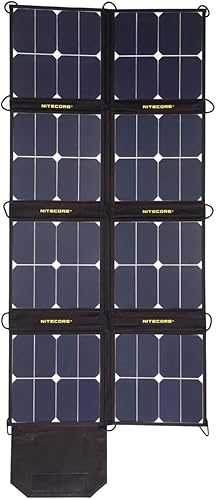
The FSP100 is a serious panel for serious trips. At 100W, it’s overkill for a solo weekend warrior but exceptional for base camping, group trips, or thru-hikers who need to charge multiple devices and a large power bank simultaneously.
- Wattage: 100W
- Weight: 1.95 kg (4.3 lbs)
- Packed size: 31 × 22 × 5 cm
- Price: ~$250
- Panel type: Monocrystalline, ETFE laminated
- Ports: DC output, USB-C PD, USB-A
Pros: Excellent conversion efficiency (~23%), charges laptops via USB-C PD, folds compactly for its output, durable ETFE coating. Multiple output ports let you charge several devices at once.
Cons: Heavy for backpacking — this is a carry-to-camp panel, not a clip-to-your-pack panel. The price is steep. Most solo backpackers won’t need 100W.
Best for: Base campers, group trips, thru-hikers with extensive electronics.
2. Goal Zero Nomad 10 — The Reliable Standby
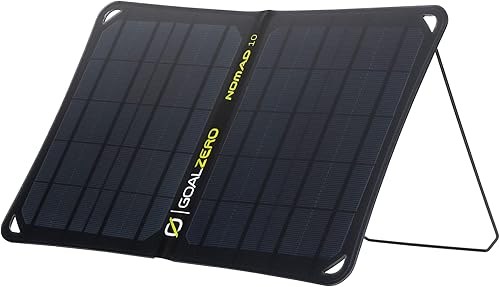
Goal Zero essentially created the portable solar market, and the Nomad 10 remains one of the most popular panels on trail. It’s not the lightest or most powerful, but the build quality and brand support are excellent.
- Wattage: 10W
- Weight: 454g (1 lb)
- Packed size: 24 × 17 × 2.5 cm
- Price: ~$50
- Panel type: Monocrystalline
- Ports: USB-A (8W max output)
Pros: Rugged construction, built-in kickstand for angle adjustments, pairs perfectly with Goal Zero power banks (Flip and Venture series). Compact fold-out design. Proven track record with thousands of trail miles from the backpacking community.
Cons: Only USB-A output — no USB-C. At 454g, it’s heavier than some 20W alternatives. 10W is slow for charging anything beyond phones. No built-in charge controller; output fluctuates with passing clouds.
Best for: Casual backpackers who want proven reliability without overthinking specs.
3. Anker 625 Solar Panel — Best Value
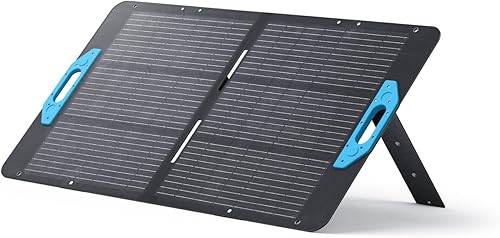
Anker’s 625 brings the company’s charging expertise into the solar space. The 100W output at this price point is genuinely impressive, and the Suncast alignment technology helps you angle the panel for maximum output.
- Wattage: 100W
- Weight: 5 kg (11 lbs)
- Packed size: 52.5 × 37.8 × 8.5 cm
- Price: ~$200
- Panel type: Monocrystalline
- Ports: USB-C (PD 30W), USB-A, XT-60 for Anker power stations
Pros: Outstanding value for 100W output. USB-C PD support. Adjustable kickstand. Scratch-resistant surface. Pairs with Anker power stations via XT-60. Anker’s 18-month warranty is solid.
Cons: At 5 kg, this is a car-camping and base-camp panel — nobody is backpacking with this. Bulky when folded. The 100W rating is under lab conditions; real output sits closer to 60–75W.
Best for: Car campers and base campers who want maximum watts per dollar.
4. BioLite SolarPanel 5+ — Best Integrated Design
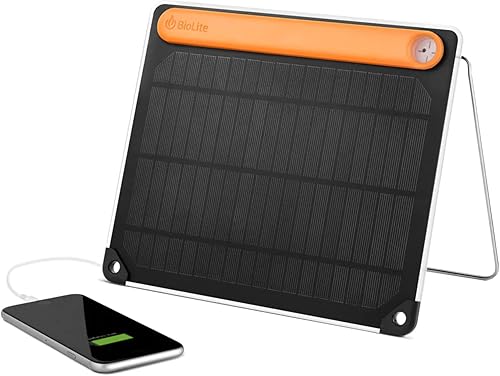
BioLite’s clever design integrates a 2,200 mAh battery directly into the panel. The sundial alignment tool on the front helps you angle the panel perfectly, and the onboard battery captures power even when nothing is plugged in.
- Wattage: 5W
- Weight: 390g (13.8 oz)
- Packed size: 26 × 20 × 2 cm
- Price: ~$80
- Panel type: Monocrystalline
- Ports: USB-A (built-in 2,200 mAh battery)
Pros: The integrated battery is a game-changer. The panel charges the battery throughout the day, then you plug in your phone at camp — no direct-sun dependency during charging. The sundial makes angle optimization dead simple. Slim profile sits nicely on a pack.
Cons: Only 5W output — this is a trickle charger. The 2,200 mAh battery is small (about 60% of one phone charge). Only USB-A. The battery adds weight without adding panel wattage.
Best for: Minimalist hikers who want set-it-and-forget-it solar without managing cables during the day.
5. BigBlue 28W — Budget Pick with Real Power
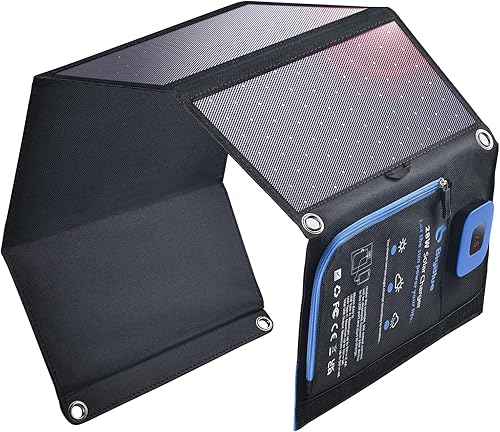
The BigBlue 28W consistently punches above its price class. Four foldable panels provide genuine 28W output, and it’s one of the best-performing panels in partially cloudy conditions thanks to its SunPower cells.
- Wattage: 28W
- Weight: 533g (18.8 oz)
- Packed size: 28.2 × 16 × 3.4 cm
- Price: ~$66
- Panel type: SunPower monocrystalline
- Ports: 3× USB-A (5V/2.4A each)
Pros: Remarkable price for 28W. Three USB ports for multi-device charging. IPX4 splash resistance. SunPower cells perform well in low-light conditions compared to standard monocrystalline. The four-panel fold-out catches more sun area than dual-panel designs.
Cons: No USB-C — all three ports are USB-A. At 533g, it’s not ultralight. The large fold-out area makes it awkward clipped to a pack while hiking. No built-in charge controller; needs steady sun for consistent output.
Best for: Budget-conscious hikers who want serious charging power and don’t mind the size trade-off.
Solar Charger Comparison Table
| Panel | Wattage | Weight | Packed Size | Price | Best For |
|---|---|---|---|---|---|
| Nitecore FSP100 | 100W | 1.95 kg | 31 × 22 × 5 cm | ~$250 | Extended trips, groups |
| Goal Zero Nomad 10 | 10W | 454g | 24 × 17 × 2.5 cm | ~$50 | Reliability-first hikers |
| Anker 625 | 100W | 5 kg | 52.5 × 37.8 × 8.5 cm | ~$200 | Car/base camp value |
| BioLite SolarPanel 5+ | 5W | 390g | 26 × 20 × 2 cm | ~$80 | Integrated battery convenience |
| BigBlue 28W | 28W | 533g | 28.2 × 16 × 3.4 cm | ~$66 | Budget power |
Tips for Maximum Charging Efficiency
A solar panel is only as good as how you use it. These habits consistently improve real-world output.
- Angle toward the sun. A panel lying flat on your pack gets significantly less energy than one angled perpendicular to the sun’s rays. During lunch breaks, prop your panel against a rock or your pack at roughly a 45–60° angle facing the sun. This alone can increase output by 25–40% compared to laying it flat.
- Prioritize direct sunlight. Partial shade kills output disproportionately. Even one cell in shadow can reduce the entire panel’s output by 50% or more, depending on the panel’s wiring configuration. Move your panel as shadows shift.
- Keep panels clean. Dust, pollen, and moisture on the surface reduce light absorption. A quick wipe with a bandana before use makes a measurable difference, especially in dusty desert environments.
- Charge during breaks, not while hiking. Clipping a panel to your pack while hiking looks cool in Instagram photos, but the constant movement, varying angles, and your own body shadow reduce output dramatically. You’ll get more total energy from 2 hours of stationary direct-sun charging during lunch than 6 hours of bouncing on your pack.
- Charge your power bank, not your phone. Solar output fluctuates. Cloud passes, you stop for a water crossing, shadows from trees — these interruptions frustrate phone charging circuits that expect consistent power. Instead, charge a power bank during the day (they handle intermittent input better), then charge your phone from the power bank at camp.
- Start early in the day. Set up your panel at your first rest stop, not at camp in the evening. You want peak sun hours (roughly 10am–3pm). Afternoon thunderstorms are common in mountain environments and can eliminate your evening charging window entirely.
Pairing Your Solar Charger with a Power Bank
A solar panel without a power bank is like a stove without fuel — technically functional but impractical. The power bank acts as your battery buffer, storing energy during sunny hours for use anytime.
Recommended Combinations
Ultralight setup (3–5 day trips): BioLite SolarPanel 5+ paired with a 5,000 mAh power bank. Total weight under 500g with the panel’s integrated battery. Good for phone-only users in sunny terrain.
Standard setup (5–10 day trips): BigBlue 28W or Goal Zero Nomad 10 paired with a 10,000 mAh power bank (like the Nitecore NB10000 at 150g). Total system weight around 600–700g. Handles phone, headlamp, and GPS charging comfortably.
Heavy-use setup (thru-hikes, content creators): Nitecore FSP100 paired with a 20,000 mAh power bank. Total weight starts around 2.3 kg. Supports phone, camera, laptop, and multiple small devices. Only justified for long trips with heavy electronics use.
Capacity Guide
As a rule of thumb, your power bank should hold 2–3 days of charging capacity as a buffer for cloudy stretches. A typical smartphone battery is 3,500–5,000 mAh. If you use about 60% of your phone per day on trail (GPS tracking, photos, occasional messaging), you need roughly 2,500–3,000 mAh daily. A 10,000 mAh power bank gives you a 3-day buffer — enough to ride out a storm system without sun.
Frequently Asked Questions
Can I charge my phone directly from a solar panel while hiking?
Technically yes, but it’s inefficient. Your phone’s charging circuit expects steady power input. Solar fluctuates constantly while hiking — your body shadows the panel, angles change with each step, and trees interrupt sunlight. Many phones will repeatedly start and stop charging, which can actually be harder on the battery long-term. Charge a power bank from the solar panel during rest stops, then charge your phone from the power bank.
How long does it take to charge a phone with a solar panel?
In direct, unobstructed sunlight, a 10W panel takes roughly 3–4 hours to charge a modern smartphone from empty. A 20–28W panel can do it in 1.5–2.5 hours. These are best-case numbers — real conditions with clouds, angle variation, and heat typically add 30–50% more time. Planning for 3 hours with a 20W+ panel is a safe estimate.
Are solar chargers worth the weight for backpacking?
It depends entirely on trip length and terrain. For 1–3 day trips, a power bank alone is lighter and more reliable. For trips beyond 5 days in exposed terrain (alpine, desert, open ridgelines), a solar panel paired with a smaller power bank often weighs less total than carrying enough battery capacity for the entire trip. The breakeven point is typically around day 5–7 for most setups.
Do solar chargers work in cloudy weather?
They work, but at severely reduced capacity. Expect 10–25% of rated output under overcast skies. Heavy cloud cover can drop output to nearly zero for practical charging purposes. This is exactly why pairing a solar charger with a power bank is essential — the battery covers you during cloudy stretches while the panel recharges it when sun returns.
What wattage solar panel do I need for backpacking?
For most solo backpackers charging a phone and headlamp, 10–20W is the sweet spot between weight and usefulness. If you’re running a GPS, satellite communicator, and camera, step up to 20–28W. Panels above 28W are generally too heavy for on-foot travel and better suited to base camping or car camping. Match the panel wattage to your actual daily power consumption, not a theoretical maximum.