
First Time Backpacking: Everything You Need to Know
Here’s a secret that every grizzled thru-hiker won’t tell you at the trailhead: they were once exactly where you are right now. Nervous. Wondering if they packed too much or too little. Quietly Googling “do bears actually eat people” at 2 AM. Every single one of them.
I’ve been backpacking for over fifteen years, and I still remember my first overnight trip with startling clarity. My pack weighed an absurd 45 pounds. I brought three flashlights “just in case.” I wore brand-new boots that gave me blisters before I hit the first mile marker. And you know what? I had one of the best nights of my life sleeping under stars I didn’t know existed.
First time backpacking doesn’t have to be intimidating. It’s really just walking, eating, and sleeping — but in a much better setting than your apartment. This beginner backpacking guide covers everything you actually need to know, without the gatekeeping or the overwhelming gear lists. Let’s get you out there.
Before Your First Trip
The single biggest mistake beginners make isn’t on the trail — it’s in the planning. Either they over-plan to the point of paralysis, or they wing it entirely. You want to land somewhere in the middle.
Choose an Easy Trail
Your first overnight hike is not the time to test your limits. Look for trails that are:
- 3 to 6 miles to your campsite — far enough to feel like an adventure, close enough that you can bail if you need to
- Under 1,000 feet of elevation gain — a gradual incline, not a quad-burning ascent
- Well-marked and well-traveled — you want other hikers around for your first go
- Near a reliable water source — carrying all your water for 24+ hours adds serious weight
Check AllTrails, local hiking forums, or your nearest ranger district for “beginner backpacking” recommendations. National Forests often have shorter loop trails with designated backcountry campsites that are perfect for a first trip.
Do Your Research
Before you hit the trail, know these things cold:
- Distance and elevation profile — not just total miles, but where the steep parts are
- Water source locations — mark them on your map or in your GPS app
- Weather forecast — check it the day before and the morning of your trip
- Permit requirements — some areas require backcountry permits, even for one night
- Cell service — assume you won’t have any, and plan accordingly
Tell Someone Your Plans
This isn’t optional. Tell a trusted friend or family member exactly where you’re going, which trailhead you’re starting from, and when you expect to be back. Give them a “if you haven’t heard from me by X time, call the ranger station” deadline. It takes two minutes and could save your life.
Essential Gear for Your First Trip
Here’s where most beginners spiral. You start browsing gear sites and suddenly you’re convinced you need a $600 tent, a titanium spork, and a GPS device that costs more than your first car. You don’t.
The Big 3
Your three heaviest items will be your shelter, sleep system, and backpack. These are worth spending some time choosing, because they make up roughly 60% of your pack weight.
- Backpack (50-65 liters): For your first trip, a 55-liter pack is the sweet spot. Make sure it fits your torso length, not your height. Get fitted at an outdoor store if you can — this matters more than brand.
- Tent or shelter: A freestanding two-person tent is most forgiving for beginners. You get extra space for gear, and freestanding means you can pitch it on any surface without needing perfect staking conditions.
- Sleeping bag + pad: Match your bag’s temperature rating to the coldest temps you’ll encounter, then subtract 10 degrees for a comfort buffer. Your sleeping pad matters just as much — it insulates you from the cold ground, not just cushions you.
What You Actually Need vs. What You Think You Need
You need: a way to sleep, a way to eat, a way to drink clean water, a way to navigate, a first aid kit, and appropriate clothing. That’s the core of it.
You don’t need: a camp chair, a full-size pillow, a change of clothes for every day, a hatchet, a massive knife, cotton anything, or more than one book. Every ounce adds up when you’re climbing a switchback at mile four.
Borrow or Rent Before You Buy
This is the single best piece of beginner backpacking advice I can give: don’t buy everything for your first trip. Borrow a tent from a friend. Rent a pack from REI or your local outdoor shop. Many outdoor clubs and university programs loan gear for free or cheap. You’ll learn what features matter to you after your first trip, and then you can buy with confidence instead of guessing.
Packing Your Pack
How you pack matters almost as much as what you pack. A poorly loaded 25-pound pack can feel worse than a well-packed 35-pound one.
Weight Distribution
Think of your pack in three zones:
- Bottom: Sleeping bag, sleeping pad (if it’s not strapped outside), and clothes you won’t need until camp. Light, bulky stuff.
- Middle (close to your back): Heavy items — food, water, stove, bear canister. You want the weight centered between your shoulder blades and hips, tight against your spine.
- Top and pockets: Things you need during the day — rain jacket, snacks, map, sunscreen, headlamp, first aid kit.
The “Lighter Is Better” Mindset
You don’t need to become an ultralight zealot for your first trip, but adopting the mindset helps. For every item, ask: Do I actually need this, or am I bringing it because I’m afraid of not having it? Fear packing adds pounds fast.
A good rule of thumb for beginners: aim for a base weight (everything except food, water, and fuel) under 20 pounds. Under 25 is totally workable. Over 30 and you’re going to feel every single mile.
On the Trail
Find Your Pace
Beginners almost always start too fast. You’re excited, the trail is fresh, and you feel great — for the first mile. Then the pack starts biting into your shoulders and your lungs remind you that you skipped cardio for the last six months.
Start slow. Embarrassingly slow. You should be able to hold a conversation without gasping. Plan for about 2 miles per hour with a pack, slower on uphills. Take breaks every 45-60 minutes. There’s no trophy for finishing first — the whole point is being out here.
Water Sources
Never pass a water source without topping off, especially if you’re unsure when the next one comes. Carry at least 2 liters of capacity, more in hot or dry conditions. If your trail has reliable streams or lakes, you can carry less and filter as you go.
Trail Etiquette
A few unwritten rules that will keep you in everyone’s good graces:
- Uphill hikers have the right of way — though most will wave you past while they catch their breath
- Step to the downhill side when yielding to other hikers or pack animals
- Keep your music to your headphones — nobody hiked five miles to hear your playlist
- Say hello — the trail community is friendly, and a quick greeting goes a long way
Leave No Trace Basics
These aren’t suggestions — they’re the code every backpacker lives by:
- Pack out everything you pack in, including food scraps and toilet paper
- Stay on the trail to protect fragile vegetation
- Camp on durable surfaces (established sites, rock, gravel, dry grass)
- Bury human waste in a cathole 6-8 inches deep, at least 200 feet from water
- Don’t feed wildlife — not even that adorable chipmunk
Setting Up Camp
Choosing Your Site
Look for flat ground (you’ll roll downhill all night if you don’t), natural wind protection, and proximity to water without being right on top of it. Stay at least 200 feet from lakes and streams to protect water quality and avoid the mosquito swarms that congregate near water at dusk.
If there’s an established campsite, use it. Creating new sites damages vegetation and soil that can take years to recover.
The Camp Triangle
Set up your camp in a triangle pattern with at least 200 feet between each point:
- Point 1: Your tent (sleeping area)
- Point 2: Your cooking area
- Point 3: Your food storage (bear hang or canister)
This separation keeps food smells away from where you sleep. In bear country, this isn’t a nice-to-have — it’s essential.
Tent Setup Tips
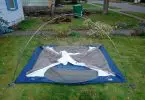
Practice setting up your tent at home before your trip. I can’t stress this enough. Fumbling with poles and stakes in fading daylight after hiking all day is miserable. Do a backyard test run and you’ll thank yourself later. Stake your tent taut, orient the door away from prevailing wind, and always use your rainfly — even if the forecast is clear.
Food & Water on the Trail
Keep Meals Simple
Your first trip is not the time to attempt backcountry gourmet cooking. Stick with meals that are:
- Lightweight and calorie-dense
- Easy to prepare (ideally just add boiling water)
- Foods you already know you like
Breakfast: Instant oatmeal with nuts and dried fruit, or granola bars and coffee. Lunch: Tortillas with peanut butter, hard cheese, and summer sausage — no refrigeration needed. Dinner: Freeze-dried backpacking meals (they’ve gotten surprisingly good), instant ramen upgraded with a packet of tuna, or instant mashed potatoes with olive oil. Snacks: Trail mix, jerky, energy bars, dried mango. Carry more snacks than you think you’ll need.
Calorie Planning
You’ll burn 3,000 to 4,500 calories per day while backpacking, depending on terrain and pack weight. You probably won’t replace all of those — and that’s fine for one night. Aim for about 2,500-3,000 calories of food, roughly 1.5 to 2 pounds of food per day.
Water Treatment
Never drink untreated water from the backcountry, no matter how crystal-clear that mountain stream looks. Your options:
- Pump filter: Reliable and immediate, but adds weight and requires effort
- Squeeze filter (like a Sawyer Squeeze): Lightweight, affordable, and the go-to for most backpackers — excellent for beginners
- Chemical treatment (Aquamira or tablets): Lightweight backup, but takes 15-30 minutes to work
- UV light (SteriPEN): Fast but requires batteries and clear water
For your first trip, a Sawyer Squeeze is hard to beat. It costs about $35, weighs 3 ounces, and filters up to 100,000 gallons.
Common First-Timer Mistakes
I’ve made every one of these. Learn from my suffering.
- Overpacking: The number one mistake, every time. If you’re not sure you need it, you don’t. That camp chair? Leave it. The extra pair of jeans? Absolutely not.
- Wearing the wrong footwear: Brand-new boots are a blister factory. Wear broken-in trail shoes or hiking boots. And for the love of everything, bring good moisture-wicking socks — your feet will thank you.
- Skipping rain gear: “But the forecast says sunny!” Weather in the backcountry changes fast. A lightweight rain jacket weighs 8-12 ounces and can save your trip. Bring it. Always.
- Not testing gear at home: Setting up your stove for the first time in the dark at camp is how you end up eating cold ramen with trail mix stirred in. Test everything — tent, stove, water filter — before you leave.
- Going too far on your first trip: Ambition is great, but your first trip should be about building confidence, not suffering through 15 miles with an untested pack. Save the epic missions for trip number three.
- Cotton clothing: Cotton absorbs sweat, holds moisture, takes forever to dry, and kills your body heat. Wear synthetics or merino wool. The old saying “cotton kills” exists for a reason.
Safety Basics
Wildlife
The vast majority of wildlife encounters are harmless and honestly pretty magical. But you should know the basics:
- Bears: Make noise on the trail so you don’t surprise them. Store food properly at night. In grizzly country, carry bear spray and know how to use it.
- Snakes: Watch where you step and where you put your hands, especially near rocks and logs. Give them space and they’ll give you space.
- Mice and rodents: More likely to bother you than bears. Hang your food or use a bear canister to keep them out of your supplies.
Weather Changes
Mountain weather is unpredictable. If you see dark clouds building, hear thunder, or the temperature drops suddenly, take action. Get below treeline during lightning. Put on layers before you’re cold, not after you’re shivering. Having a rain jacket and an insulating layer accessible at all times is non-negotiable.
Blisters
Catch hot spots early — if you feel rubbing or warmth on your feet, stop immediately and apply moleskin or athletic tape. A two-minute fix at mile two saves you from a hobbling, miserable mile six. Bring moleskin, Leukotape, or blister bandages in your first aid kit.
When to Turn Back
There is absolutely no shame in turning around. Bad weather rolling in, an injury, gear failure, or simply feeling unsafe — these are all valid reasons to head back to the trailhead. The trail will be there next weekend. Making it home safe means you get to go again.
Recommended First Trips
These are proven beginner-friendly overnight trails across different US regions — short enough to be manageable, scenic enough to get you hooked.
Northeast
- Harriman State Park, NY: Multiple loop options with lean-tos, 4-8 miles, gentle terrain just an hour from NYC
- Dolly Sods Wilderness, WV: Open meadows with stunning views, several 5-7 mile out-and-back options with established campsites
Southeast
- Max Patch via the AT, NC: A 6-mile out-and-back to one of the most famous bald summits on the Appalachian Trail, with 360-degree views
- Congaree National Park, SC: Flat boardwalk trails through old-growth bottomland forest, with backcountry camping just 2-4 miles in
Midwest
- Pictured Rocks, MI: Chapel Loop is a stunning 10-mile loop, but the Chapel Falls to Chapel Rock out-and-back (6 miles) is more beginner-friendly
West
- Lost Coast Trail (southern section), CA: Beach walking with dramatic cliffs, 7-8 miles to a perfect campsite — check tide tables
- Enchanted Valley, WA (Olympic National Park): 13 miles one way, but flat river trail — do just the first 6 miles to a riverside camp
Southwest
- Grand Canyon — South Kaibab to Bright Angel, AZ: Strenuous but iconic, with Bright Angel Campground at the bottom (permit required, book months ahead)
- Wheeler Peak, NM: Several overnight options in the Carson National Forest with alpine lakes and sub-alpine meadows
Frequently Asked Questions
How much does it cost to start backpacking?
If you buy everything new, expect to spend $500-$800 for decent beginner gear (pack, tent, sleeping bag, pad, stove, filter). But you can cut that dramatically by borrowing, renting, or buying used. Check REI’s used gear site, Facebook Marketplace, and r/GearTrade. Many people start with under $200 by borrowing the Big 3 and buying only small essentials.
Do I need to be in great shape to go backpacking?
No. You need to be able to walk 3-6 miles at a slow pace with weight on your back. That’s it for a first trip. If you can walk for two hours without stopping, you can backpack. Start with a short, easy trail and build up from there. The fitness comes with the doing.
Is backpacking alone safe for beginners?
For your very first trip, going with an experienced friend or joining a group is ideal. Many outdoor clubs, Meetup groups, and REI locations offer guided beginner backpacking trips. If you do go solo on your first trip, stick to popular, well-marked trails and make sure someone knows your exact itinerary.
What if it rains on my first backpacking trip?
Rain is part of backpacking — and honestly, falling asleep to rain on your tent fly is one of the best sounds in nature. Bring a rain jacket, pack a rain cover for your backpack (or line the inside with a trash bag), and keep dry clothes sealed in a waterproof bag for sleeping. As long as you stay dry at night, daytime rain is just an inconvenience, not a crisis.
How do I go to the bathroom in the backcountry?
For solid waste, dig a cathole 6-8 inches deep at least 200 feet from water, trails, and campsites. Do your business, and pack out your toilet paper in a sealed ziplock bag (yes, really — it doesn’t decompose as fast as you think). For liquid waste, move at least 200 feet from water sources. Bring a small trowel and a designated “waste bag” with some baking soda to control odor. It’s less awkward than you think after the first time.
Here’s the thing about first time backpacking: it doesn’t need to be perfect. Your pack will probably be too heavy. You’ll forget something. You might not sleep great. And none of that matters, because you’ll wake up in the morning to a view that no hotel window can match, cook coffee on a stove the size of your fist, and walk home with the quiet confidence that comes from knowing you can do this.
So pick a trail. Borrow a tent. Pack your bag. And go. The backcountry has been waiting for you.
Featured Image Source: Pexels