

Backpacking Safety: Complete Guide to Staying Alive in the Wilderness
Here’s the truth about backpacking safety that most guides won’t lead with: the wilderness isn’t trying to kill you. According to the National Park Service, fewer than 1 in 2 million visitors to national parks die from unintentional injuries each year. You’re statistically safer on a trail than on your commute to work.
But that statistic comes with a caveat. The people who stay safe in the backcountry are overwhelmingly the ones who prepared for it. The vast majority of search-and-rescue incidents — over 80% by most SAR team estimates — stem from preventable mistakes: poor planning, inadequate gear, overestimating ability, or underestimating conditions.
This guide covers every major hazard you’ll face on the trail, from wildlife encounters to weather emergencies to navigation failures. More importantly, it gives you concrete, actionable steps to prevent them. Whether you’re planning your first overnight trip or your fiftieth, treat this as your backcountry safety checklist.
Pre-Trip Planning: Your Safety Starts at Home
Most backcountry emergencies don’t begin on the trail. They begin at the kitchen table, when someone skips the planning phase. Proper pre-trip preparation is the single most effective safety measure you can take.
Tell Someone Your Plans
Leave a detailed trip plan with a trusted person who will actually act on it if you don’t check in. Your plan should include:
- Trailhead name and parking location
- Planned route with campsites for each night
- Expected return date and time
- Vehicle description and license plate
- What to do if you don’t return on time (specific instructions: “Call the county sheriff’s office at [number] if I haven’t contacted you by 8 PM on Sunday”)
Don’t just text a friend “going hiking this weekend.” That’s not a trip plan. That’s a vague status update that won’t help anyone find you.
Research the Area
Before every trip, research these specifics:
- Current trail conditions — Check ranger station reports, recent trip reports on AllTrails or forums, and social media posts from other hikers
- Weather forecast — Look at both valley and summit forecasts. Mountain weather can differ by 20-30°F from the trailhead. Check forecasts 48 hours before departure and again at the trailhead
- Permit requirements — Some areas require permits for day hiking, overnight camping, or campfires. Getting turned away at a trailhead isn’t a safety issue, but improvising an unfamiliar alternate route is
- Water source status — Seasonal springs dry up. Snowmelt-fed streams disappear by late summer. Confirm your water sources are flowing before you depend on them
- Wildlife activity — Check for recent bear activity, mountain lion sightings, or seasonal closures
Match the Trip to Your Experience
Be honest about your fitness level and technical skills. A trail rated “moderate” by experienced hikers may be grueling for a beginner carrying a 35-pound pack. If your longest hike has been 8 miles on flat terrain, don’t start with a 15-mile mountain traverse with 4,000 feet of elevation gain.
Wildlife Safety: Coexisting with Animals That Were Here First
Bears
Your response to a bear encounter depends entirely on the species, and getting it wrong can be fatal.
Black bears (found across North America): Make yourself look large. Shout, bang pots, throw rocks. Do not run. If a black bear attacks, fight back aggressively — target the nose and eyes. Black bears that attack humans are almost always treating you as prey, and fighting back is your best defense.
Grizzly bears (found in the Northern Rockies, Alaska, and parts of the Pacific Northwest): Do not run. Speak in calm, low tones. Back away slowly. If a grizzly charges, it’s often a bluff — stand your ground. If a grizzly makes contact, play dead: lie face down, spread your legs to prevent being rolled over, and lace your fingers behind your neck. The exception: if a grizzly attacks at night or stalks you deliberately, fight back. That’s predatory behavior.
Bear spray works. Studies published in the Journal of Wildlife Management show bear spray stops aggressive bear behavior in over 90% of cases, outperforming firearms. Carry it accessible — not buried in your pack — and know how to deploy it (remove safety, aim slightly downward, spray in a 2-second burst at 20-30 feet).
Mountain Lions
Mountain lion attacks are rare — roughly 4-6 fatal attacks per decade in North America — but they happen. Never run from a mountain lion. Face the animal, make yourself appear large by raising your arms or jacket above your head, maintain eye contact, shout, and throw rocks or sticks. If attacked, fight back with everything you have. Mountain lions tend to abandon prey that fights.
Snakes
Watch where you put your hands and feet, especially when stepping over logs or reaching onto ledges. Most snakebites happen when people try to handle or kill snakes. If bitten by a venomous snake: stay calm, immobilize the affected limb, remove jewelry or tight clothing near the bite, and evacuate immediately. Do not cut the bite, apply a tourniquet, or try to suck out venom — all of these cause more harm.
Moose
Moose injure more people in North America than bears and mountain lions combined. They’re not aggressive by nature, but they’re unpredictable, especially cows with calves and bulls during the fall rut. Give moose at least 50 yards of space. If a moose charges, get behind a large tree or solid obstacle — they can’t change direction quickly. Unlike bear encounters, running from a moose is often the right call.
Ticks and Mosquitoes
The most dangerous animals in the backcountry aren’t the large ones. Tick-borne illnesses like Lyme disease affect roughly 476,000 Americans annually. Use permethrin-treated clothing, apply DEET or picaridin to exposed skin, conduct full-body tick checks every evening, and remove embedded ticks with fine-tipped tweezers using steady upward pressure. Save the tick in a sealed bag in case you develop symptoms later.
Weather Hazards: Reading the Sky
Lightning
Lightning kills roughly 20 people per year in the United States, and hikers on exposed ridgelines are particularly vulnerable. Follow the 30/30 rule: if the time between a lightning flash and thunder is 30 seconds or less (6 miles), seek shelter immediately. Wait 30 minutes after the last thunder before resuming.
If caught in the open: descend from ridgelines and peaks immediately. Avoid isolated trees, bodies of water, and metal objects. Crouch on the balls of your feet with your feet together, minimizing ground contact. Spread your group out — at least 50 feet apart — so a single strike doesn’t incapacitate everyone.
Hypothermia
Hypothermia kills more backcountry travelers than any other environmental hazard, and it doesn’t require freezing temperatures. Wet, windy conditions in the 40-50°F range are the most dangerous because people underestimate the risk. Watch for the “umbles”: stumbling, mumbling, fumbling, grumbling. Treat early by getting the person dry, insulated from the ground, and warmed with hot drinks and body heat. Severe hypothermia (confusion, loss of coordination, slurred speech) requires evacuation.
Heat Stroke
Heat exhaustion is manageable in the field: move to shade, cool the skin, hydrate. Heat stroke — marked by hot, dry skin, confusion, and a core temperature above 104°F — is a life-threatening emergency. Cool the person aggressively (submerge in cold water if available, apply wet cloths to the neck, armpits, and groin) and evacuate immediately.
Flash Floods
Never camp in a dry wash, arroyo, or narrow canyon floor, especially in desert environments. Flash floods can arrive with no local rainfall — the storm may be miles upstream. If water begins rising, move to high ground immediately. It takes just 6 inches of fast-moving water to knock an adult off their feet.
Water Safety: Crossings, Treatment, and Hydration
Stream Crossings
Unbuckle your pack’s sternum strap and hip belt before crossing any stream deeper than knee-height. If you fall in, you need to be able to shed your pack instantly. Use trekking poles or a sturdy stick for a third point of contact. Cross at the widest, shallowest point — not the narrowest. Face upstream and move diagonally with the current, not against it.
Water Treatment
Treat all backcountry water, no matter how clear it looks. Giardia, Cryptosporidium, and other pathogens are invisible. Your options: chemical treatment (chlorine dioxide tablets — effective but slow, 4 hours for Crypto), UV treatment (SteriPEN — fast but battery-dependent), or filtration (pump or gravity filters rated to 0.2 microns). Carry a backup method.
Recognizing Dehydration
By the time you feel thirsty, you’re already mildly dehydrated. Monitor your urine color — pale yellow is the target. Dark yellow or amber means drink immediately. Symptoms of serious dehydration include headache, dizziness, rapid heartbeat, and decreased urine output. In hot conditions, plan to drink 1 liter per hour of strenuous hiking.
Navigation and Getting Lost: Stay Found
GPS devices and phone apps are excellent tools, but they fail. Batteries die, screens crack, satellites lose signal in deep canyons. Always carry a paper topographic map and a baseplate compass, and know how to use them together. Practice at home before your trip — a trailside emergency is not the time to learn orienteering.
The STOP Method
If you realize you’re lost, use the STOP method:
- Stop — Sit down. Do not keep walking. Panic-driven movement makes everything worse
- Think — When did you last know your location? What landmarks do you remember?
- Observe — Look at your map. Check your compass. Examine the terrain around you for identifiable features: ridgelines, drainages, trail junctions
- Plan — If you can identify your location, navigate back to the last known point. If you can’t, stay put and make yourself visible for search and rescue
The single biggest mistake lost hikers make is continuing to walk. SAR teams find people fastest when they stay in one place.
First Aid Essentials: Treating Common Trail Injuries
Blisters
Address hot spots immediately — do not wait until a blister forms. Apply moleskin or athletic tape at the first sign of irritation. If a blister has already formed and is painful enough to affect your gait, drain it with a sterilized needle at the base, leave the skin intact as a natural bandage, apply antibiotic ointment, and cover with moleskin with a donut hole cut around the blister.
Sprains
Ankle sprains are the most common backcountry injury. Apply the RICE protocol: Rest, Ice (use a cold stream), Compression (wrap with an elastic bandage), Elevation. If you can bear weight, use trekking poles for support and hike out slowly. If you can’t bear weight, splint the joint and call for help.
Cuts and Wounds
Clean wounds thoroughly with treated water. Apply pressure to stop bleeding. Use butterfly closures or medical tape to close clean lacerations. Watch for signs of infection over the following days: increasing redness, warmth, swelling, or red streaks extending from the wound.
Allergic Reactions
If anyone in your group has a known severe allergy, they should carry two epinephrine auto-injectors (EpiPens). After administering epinephrine for anaphylaxis, evacuate immediately — the medication is a bridge, not a cure. Even without known allergies, carry diphenhydramine (Benadryl) for unexpected reactions to stings or plants.
When to Evacuate
Evacuate for: suspected fractures, inability to bear weight, signs of severe infection, persistent vomiting or diarrhea causing dehydration, chest pain, difficulty breathing, altered mental status, or any injury that’s getting worse despite treatment.
Camp Safety: Where and How You Sleep Matters
Food Storage
In bear country, store all food, trash, toiletries, and scented items in a bear canister or hang them from a tree at least 200 feet from your tent, 12 feet off the ground, and 6 feet from the trunk. Cook and eat at least 200 feet downwind from your sleeping area. Never bring food into your tent — not even a wrapper.
Campfire Safety
Check fire restrictions before your trip. If fires are permitted, use established fire rings, keep fires small, burn only dead and downed wood, and never leave a fire unattended. To extinguish: drown with water, stir the ashes, drown again, and confirm with the back of your hand that no heat remains.
Tent Placement
Choose your campsite with hazard awareness. Avoid: dead trees and hanging branches (called “widow-makers” for good reason), dry riverbeds, exposed ridgelines, the base of steep slopes prone to rockfall, and lone trees in open areas during storm season. Look for natural windbreaks, level ground slightly elevated from the surrounding area, and good drainage.
Solo Backpacking Safety: Extra Precautions for Going Alone
Solo backpacking is one of the most rewarding ways to experience the wilderness, but it demands higher standards of preparation because there’s no one to help if things go wrong.
Communication Devices
Cell phones are unreliable in the backcountry. For solo trips, carry a satellite communication device. Your two main options:
- Personal Locator Beacons (PLBs) — One-button emergency devices that transmit your GPS coordinates to search and rescue via the international COSPAS-SARSAT satellite system. No subscription fee. No two-way communication. Battery lasts 5+ years in standby. Best for: budget-conscious hikers who want emergency-only capability
- Satellite messengers (Garmin inReach, ZOLEO, SPOT) — Allow two-way text messaging, location tracking, weather forecasts, and SOS functions. Require monthly subscription ($12-65/month). Best for: solo hikers who want to check in with contacts and have non-emergency communication ability
Extra Solo Precautions
- Choose well-traveled trails for your first solo trips
- Be more conservative with river crossings, scrambles, and off-trail travel
- Carry more comprehensive first aid supplies than you would with a group
- Send location check-ins on a regular schedule so your emergency contact knows you’re okay
- Know your bail-out routes — alternate paths to trailheads or roads in case you need to cut the trip short
Emergency Preparedness Checklist
The “Ten Essentials” system, developed by The Mountaineers, is the foundation of backcountry preparedness. Never hit the trail without these:
- Navigation — Topographic map, compass, and GPS device or phone with offline maps
- Headlamp — Plus extra batteries. Getting caught in the dark without light turns a minor situation into a dangerous one
- Sun protection — Sunscreen (SPF 30+), sunglasses, hat. Sunburn at altitude is fast and severe
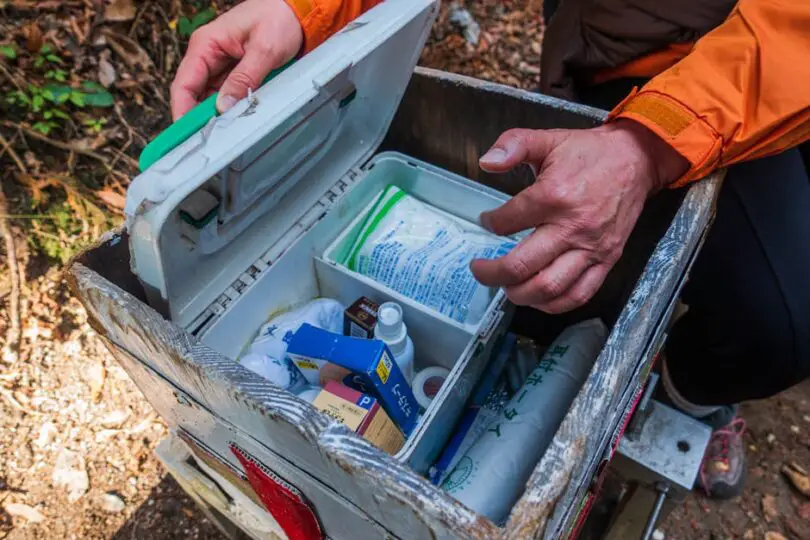
- First aid kit — See contents below
- Knife/repair tools — Multi-tool, duct tape, cord for gear repairs
- Fire — Waterproof matches, lighter, and fire starter (cotton balls with petroleum jelly work well)
- Emergency shelter — A lightweight bivy sack or SOL emergency blanket weighs ounces and can save your life in an unplanned night out
- Extra food — At least one extra day’s worth of calorie-dense food
- Extra water — Additional capacity plus a backup purification method
- Extra clothing — Insulation layers and rain protection beyond what you’d normally carry for the conditions
First Aid Kit Contents
A backcountry first aid kit should include:
- Adhesive bandages (assorted sizes), gauze pads, medical tape, elastic bandage
- Moleskin and blister treatment supplies
- Antibiotic ointment, antiseptic wipes, alcohol swabs
- Ibuprofen, acetaminophen, diphenhydramine (Benadryl), anti-diarrheal medication
- Tweezers (tick removal), safety pins, small scissors or trauma shears
- SAM splint or improvised splinting material
- Irrigation syringe for wound cleaning
- Nitrile gloves
- Emergency information card with blood types and allergies for each group member
Frequently Asked Questions
What is the most dangerous part of backpacking?
Statistically, the most dangerous aspects of backpacking are water crossings, falls on steep terrain, and hypothermia from exposure — not wildlife encounters, which receive disproportionate attention. Poor weather preparedness and attempting terrain beyond your skill level account for the majority of SAR rescues in the United States. Proper planning and honest self-assessment of your abilities are your most effective safety tools.
Is it safe to go backpacking alone?
Solo backpacking is safe with proper preparation. Thousands of hikers complete long-distance trails like the Appalachian Trail and Pacific Crest Trail alone every year. The key differences for solo travel: carry a satellite communication device (PLB or satellite messenger), leave a detailed trip plan with someone reliable, choose trails appropriate for your experience level, and be more conservative in your decision-making since there’s no partner to help if something goes wrong.
How do you stay safe from bears while backpacking?
Store all food, trash, and scented items in a bear canister or bear hang at least 200 feet from your sleeping area. Cook and eat away from your tent. Carry bear spray in bear country and know how to deploy it. Make noise on the trail to avoid surprising bears. Keep a clean camp — never bring food or scented products into your tent. In most of North America, bear encounters that follow these protocols end without incident.
What should I do if I get lost while backpacking?
Use the STOP method: Stop moving immediately, Think about your last known location, Observe your surroundings and check your map and compass, then Plan your next move. If you can confidently retrace your steps to a known point, do so carefully. If you cannot determine your location, stay put, make yourself visible (bright clothing, signal mirror, whistle — three blasts is the universal distress signal), and wait for search and rescue. Moving when lost almost always makes the situation worse.
Do I need a first aid certification for backpacking?
While not strictly required, a Wilderness First Aid (WFA) certification is strongly recommended for anyone who backpacks regularly, especially in remote areas or with groups. A standard 16-hour WFA course teaches you to assess injuries, manage common backcountry medical problems, and make evacuation decisions — skills that are fundamentally different from urban first aid. Wilderness First Responder (WFR) is the gold standard for trip leaders and frequent backcountry travelers, requiring approximately 80 hours of training.
Featured Image Source: Pexels